
Bitcoin’s volatility has declined to multi-year lows, prompting discussion around whether this represents a structural maturation of the market or the calm before renewed turbulence. Structural factors, including institutional participation, ETFs, and regulatory clarity, suggest a more stable long-term environment. However, cyclical market patterns indicate that low volatility phases have historically preceded significant price breakouts, with upside moves more likely in the current macro and market context.
Performance of Bitcoin 180 days after volatility falls
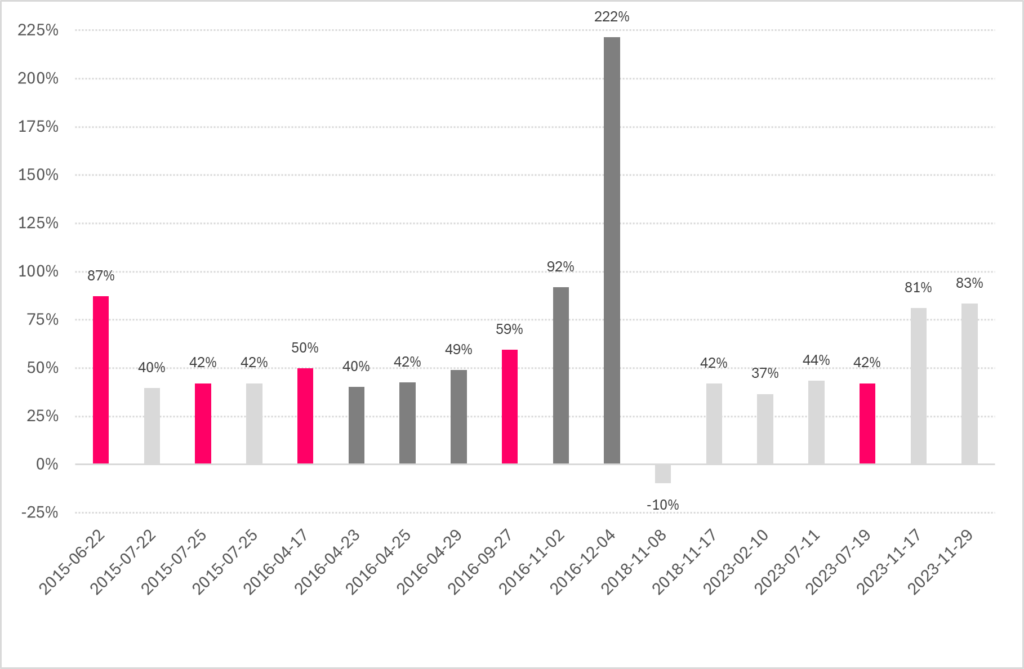
Source: CoinMarketCap, Sygnum Bank
Bitcoin’s realised volatility has remained subdued for over a year, currently running at only half of its long-term average. Similar levels were last seen in Q3 2023, just before a 60 percent rally over the following quarter and the price nearly tripling over 6 months.
Market maturation
Bitcoin’s volatility has been trending down over time as the market matures and liquidity increases. Institutional participation and the availability of instruments for hedging are supporting the trend for Bitcoin gradually shedding its high-risk characteristics.
Institutional investors (often via spot ETFs), corporations, crypto prime brokers, and hedge funds now account for a significant share of Bitcoin’s daily flows. As institutional investors typically pursue long term exposure and portfolio diversification rather than speculative trading, this dampens volatility.
Meanwhile, increased regulatory clarity and the availability of ETF structures have attracted tens of billions of institutional inflows in 2025 and improved market depth, making shocks less disruptive.
Quiet before the storm
In addition to the long term trend, market equilibrium has led to a period of exceptionally low volatility. Significant purchases by institutions and treasury companies have been met by supply from some very large, very long term holders. This balance has made breakouts to the upside relatively slow, while the sizable demand supported the downside.
Meanwhile, liquidity dynamics have remained healthy despite a growing share of bitcoin supply being illiquid, held by treasury companies. Although a fall in the liquid supply could lead to reduced liquidity which could in turn increase the size and speed of price moves, we have seen a continued rise in traded volumes.
Nonetheless, periods of market equilibria do not last, and a breakout on a catalyst is likely.
Breakout potential
As the market continues to grow in size and mature, lasting structural change, supported by stronger infrastructure, regulatory clarity, and institutional flows ensures that volatility remains on a downward trajectory.
At the same time, history shows that the current suppressed volatility is unlikely to last, and cyclical indicators also point toward a breakout.
Likely catalysts and direction
Periods of compressed volatility have consistently preceded major bitcoin price movements, and current conditions mirror prior low volatility phases that ended in strong rallies.
Institutional accumulation, continued (although decelerating) demand from treasury companies, and the macroeconomic backdrop of plentiful liquidity suggest that a breakout to the upside is more likely.
Nonetheless, geopolitical events or large liquidations by whales coupled with slowing demand pose downside risks.
Outlook
Bitcoin’s volatility will likely remain lower on average than in earlier years due to the structural evolution of the market, driven by institutionalisation and regulation.
Meanwhile, cyclical dynamics imply that a breakout is probable in the coming months, with historical precedent and market drivers suggesting a higher likelihood of upward price movement.
Summary
Bitcoin’s falling volatility reflects both structural changes in market composition and cyclical positioning. While long-term volatility is likely to remain more contained than in Bitcoin’s early years, history suggests the current lull will not last much longer, and with institutional demand, regulatory support, and strong global liquidity, the next major move is more likely to the upside.
Sign up for Future Finance
Join our 40,000 strong global community to future proof your investments. Sign up now to be the first to receive our news, product launches, industry reports and educational series.