
The CLARITY Act is the most significant regulatory catalyst for the crypto market since the US spot Bitcoin ETF approvals in early 2024. It passed the House with a very comfortable bipartisan margin of 294 to 143 in July last year, and the White House has repeatedly affirmed its support for the market structure bill. Polymarket currently prices a 51 percent probability of the bill being signed this year, but that figure has swung between 45 and 82 percent over the past three months against a backdrop of bank lobby pressure and ongoing postponements in the Senate.
Clarity Act signed into law in 2026?
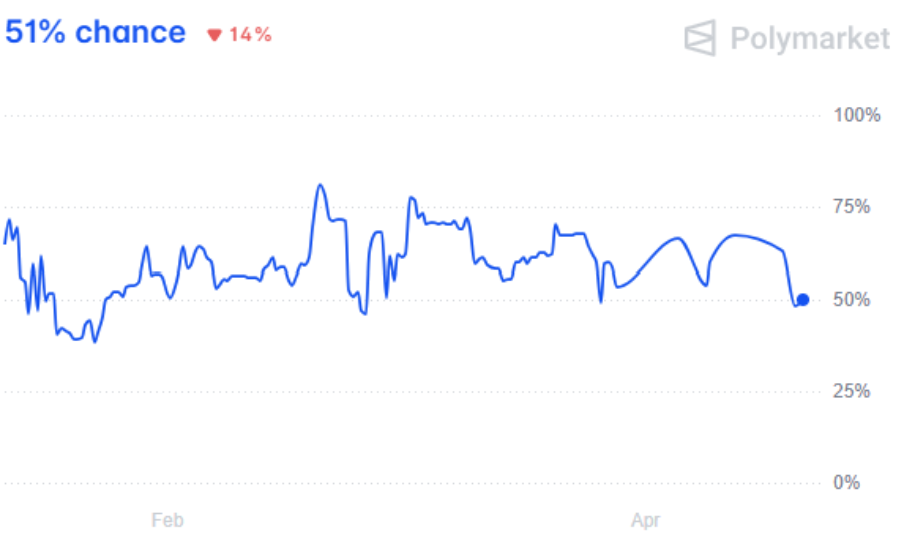
Source: Polymarket
The market’s attention has focused on whether the bill reaches final passage, but the more relevant question is what version of the bill passes when it does. The current draft text offers regulatory clarity whilst supposedly stripping the crypto industry of the yield economics that made stablecoins a competitive threat to traditional bank deposits.
What is the CLARITY Act?
The CLARITY Act attempts to resolve a decade of jurisdictional uncertainty that defined the Gensler era at the SEC. Under former chairman Gary Gensler, the SEC argued that most crypto assets were securities and launched enforcement actions against exchanges and issuers without explaining how registration would actually work. Various crypto projects naturally moved offshore as a result.
The new bill by contrast divides oversight based on the level of decentralisation. Assets on protocols that are not controlled by any single entity fall under CFTC jurisdiction as digital commodities, while assets sold as investment contracts remain with the SEC. Issuers can file to transition to a commodity status once they can demonstrate that no single entity controls the network (thresholds for token ownership and voting power are still being negotiated).
Additionally, the bill creates a registration framework for digital commodity exchanges and brokers under the CFTC, provides federal pre-emption over state securities laws, and explicitly exempts non-custodial protocols and developers that maintain open-source code.
The DeFi provisions, however, are less clear as the bill exempts decentralised protocols from intermediary requirements but does not define what qualifies as “decentralised”. This is why Democrat Senators have pushed for tighter controls, as they are concerned that loose thresholds would allow protocols to claim exemptions while avoiding AML requirements. These points will need to be addressed before any floor vote.
Banks are winning the stablecoin debate
The irony of the situation is that the core dispute holding up the CLARITY Act is not even about decentralisation thresholds or how oversight is divided between regulators, but about whether crypto platforms can pay interest on stablecoin balances.
Coinbase One subscribers earn approximately 4 percent annual yield on USDC balances, or USD 4k per year on for example a USD 100k exposure. Traditional savings accounts would offer a negligible USD 10 to 50 on the same balance (0.01 to 0.05 percent).
Banks argue that stablecoin yields function as a direct competitor to savings accounts, threatening an estimated USD 6 trillion according to BoA and JPMorgan. A Standard Chartered report also estimated that a yield provision could redirect up to half a trillion dollars from traditional banks to stablecoin products in the next two years.
Perhaps this is why over 3200 banks signed a letter to the Senate demanding the yield prohibition extend to all crypto services and not just stablecoin issuers as stipulated in the GENIUS Act. Stablecoin issuers themselves continue to earn yield on their treasury reserves.
Pressure from the bank lobby has worked as passive yield on stablecoin balances is banned in the new draft, along with any arrangement economically equivalent to “bank interest”. However, the bill does permit “activity-based rewards” such as cashback on payments, trading fee rebates, transfer bonuses, liquidity provisions and loyalty programmes.
Circle and Coinbase’s stocks fell 20 percent and 10 percent respectively on March 24 after the new draft was released (Tether’s announcement of a Big Four audit the same day also added pressure on Circle). Coinbase, which reported USD 1.35 billion in stablecoin revenue last year, withdrew its support for the bill. CEO Brian Armstrong describes the situation as “a bad bill is worse than no bill”.
The legislative calendar
The Senate returns from Easter break on April 13, with the next Banking Committee markup expected in the second half of the month, and any resulting bill will need to be reconciled with the Agriculture Committee’s version, which cleared in January without a single Democratic vote.
Midterm elections in November historically go against the sitting president’s party, and Senator Bernie Moreno has warned that if the bill does not pass by May, it will not pass for the foreseeable future as Republicans risk losing the Senate. The effective deadline for a floor vote is August when campaigning begins.
The calendar is also riddled by Trump’s insistence that he will not sign legislation until the SAVE America Act clears Congress, which it has not. White House crypto czar David Sacks, who brokered the stablecoin yield compromise between banks and crypto firms, confirmed on March 26 that his term has ended. The administration will not appoint a replacement, which leaves the CLARITY Act without its chief advocate inside the executive branch.
Meanwhile, Senator Cynthia Lummis recently described the outstanding issues as 99 percent resolved and Coinbase CLO Paul Grewal said on April 1 that he expects a deal within 48 hours.
Why the yield ban benefits DeFi
The market is treating the stablecoin yield restrictions as a major setback for the crypto industry, but this is not entirely accurate as the ban applies to non-productive stablecoin balances sitting idle in custody – not to yield earned through active deployment.
Retail users can still earn yield on stablecoins provided they deploy capital through structured instruments such as liquidity pools, lending protocols or yield vaults, which is essentially DeFi in its full form.
Coinbase does not offer stablecoin yield to free users since December last year, and the 4 percent APY is reserved only for Coinbase One subscribers paying a monthly fee. DeFi protocols offer yield to anyone who wants to deploy capital.
Admittedly, the bill’s DeFi provisions are still not entirely clear but there is no reason to expect that the yield ban would negatively affect DeFi protocols as their yield derives from lending and liquidity provision. The distinction between non-productive and productive stablecoin deployment is actually a tailwind for on-chain activity that has operated without regulatory clarity for years.
Outlook
Although the outstanding yield dispute between centralised crypto firms and the bank lobby continues, stablecoin transfer volumes surged, with Q1 2026 volumes nearing USD 29 trillion.
Stablecoin transfer volumes USDC vs others

Source: RWA.xyz
Coinbase has rejected the bill twice, but the Senate technically does not require the exchange’s endorsement to pass the legislation. Ripple, Kraken and a16z support the bill regardless of Coinbase’s objections. DeFi protocol Frax Finance also stated that the industry should accept the compromise, noting that “the activity-based yield carveout already matches how DeFi operates.”
Timing remains contested, with Wintermute pricing the odds of passage at 30 percent and the White House recently stating that a breakthrough is close. If the bill stalls beyond May, midterm priorities may take over and the much-needed regulatory clarity risks to be pushed to 2027 at the earliest, leaving the market to operate under enforcement discretion with sentiment likely to suffer as it has since the October liquidation cascade.
We expect the bill to pass this year, with well-structured altcoins achieving commodity status under the CFTC and DeFi lending protocols continuing to offer yield through lending and liquidity provision as they always have. However, we believe the bill will have marginal benefits, if any, for centralised platforms that have built their stablecoin revenue around passive yield.
Disclaimer: The information in this publication pertaining to Sygnum Bank AG (“Sygnum”) is for general information purposes only, as per date of publication, and should not be considered exhaustive. This publication does not consider the financial situation of any natural or legal person, nor does it provide any tax, legal or investment advice. This publication does not constitute any advice or recommendation, an offer or invitation by or on behalf of Sygnum to purchase or sell any assets. No elements of precontractual or contractual relationship are intended. While the information is believed to be from accurate and reliable sources, Sygnum makes no representation or warranties, expressed or implied, as to the accuracy of the information. Sygnum expressly disclaims any and all liability that may be based on such information, omissions, or errors thereof. Any statements contained in this publication attributed to a third party represent Sygnum‘s interpretation of the data, information and/or opinions provided by that third party either publicly or through a subscription service, and such use and interpretation have not been reviewed by the third party. Sygnum reserves the right to amend or replace the information, in part or entirely, at any time, and without any obligation to notify the recipient of such amendment / replacement or to provide the recipient with access to the information. Simultaneously, there is no obligation of Sygnum to inform recipients of information, if before provided information later becomes outdated, inaccurate or obsolete, unless otherwise provided by applicable law. The information provided is not intended for use by or distributed to any individual or legal entity in any jurisdiction or country where such distribution, publication or use would be contrary to the law or regulatory provisions or in which Sygnum does not hold the necessary registration, approval authorisation or license. Except as otherwise provided by Sygnum, it is not allowed to modify, copy, distribute or reproduce, display, license, or otherwise use any content for commercial purposes.
Sign up for Future Finance
Join our 40,000 strong global community to future proof your investments. Sign up now to be the first to receive our news, product launches, industry reports and educational series.