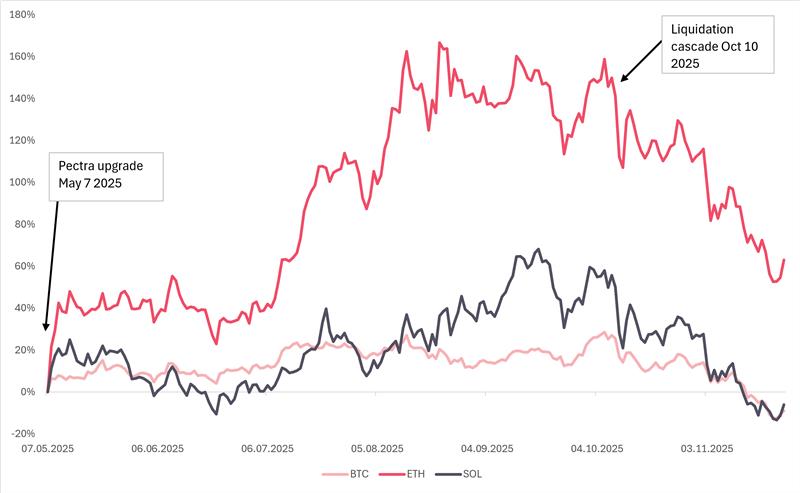
Ethereum will soon activate its long-awaited Fusaka upgrade on December 3, at a moment when ETH has experienced one of its sharpest drawdowns in the past two years. The decline followed the October 10 liquidation cascade and subsequent selling pressure across the crypto market, weighing heavily on sentiment. Despite this backdrop, Ethereum continues to progress with its ambitious scaling roadmap under its new leadership structure and a stronger commercial focus.
Price performance of Bitcoin, Ether and Solana, rebased
Source: CoinMarketCap
Since the launch of the Pectra upgrade in early May, ETH has given back most of its gains, although it has still outperformed Bitcoin and Solana over the same period. Fusaka is the next major upgrade and introduces 13 improvement proposals (EIPs) addressing how the network processes data and manages throughput. These changes are part of a substantial effort to support rising activity across Ethereum’s Layer 2 networks, while at the same time positioning the base layer to capture more value over time.
What is Fusaka?
The Fusaka upgrade, part of Ethereum’s multi-year scaling roadmap, brings immediate and meaningful improvements to how the network supports and economically benefits from its Layer 2 ecosystem. Its flagship feature, Peer Data Availability Sampling (PeerDAS, or EIP-7594), allows Ethereum to verify large transaction data blobs without requiring every node to process full datasets. This has been one of the main capacity constraints since rollups began dominating transaction and network activity on Ethereum. By verifying small samples of the data instead of the entire blob payload, the network will be able to handle far more information within each block, directly reducing costs and increasing the speed of activity across Layer 2s. In other words, Ethereum will be able to support heavier activity without imposing additional burden on the nodes that secure it.
Security (one of Ethereum’s core value propositions) is maintained because data availability is checked across a wide network of nodes, and the consensus assumptions around settlement and validation rules remain unchanged. This is important as demand and transaction activity continues to proliferate on L2 rollups.
Fusaka also includes further EIPs that improve how the base layer handles higher throughput. Block gas parameters will be updated in a way that allows blocks to absorb more activity while maintaining reliability, and several upgrades to cryptographic operations will improve the performance of hardware-based authentication and the verification processes used by many applications.
EIP-7918 will introduce a minimum base fee for blob data, which addresses a critical issue where blob fees frequently dropped to negligible levels, leaving Ethereum’s data availability market without a sustainable revenue mechanism (i.e., it is currently providing a service for the very activity it is responsible for securing for effectively nothing).
Why investors should pay attention
While Ethereum’s longstanding underperformance (and failure to hold above its previous all-time highs) continue to dominate the headlines, it is the decline in Layer 2 fees after the Dencun upgrade back in March 2024 that has led to concerns regarding poor optics over revenue. The surge in new Layer 2 activity over the past year has also complicated the investment picture, as lower fees on rollups often make it harder for investors to understand the real impact of Ethereum’s protocol upgrades in the short-term.
Fusaka introduces several improvements that will influence how value flows through Ethereum’s base layer, and the most direct beneficiary is Layer 1 block space (i.e., where transactions are finalised and users pay network fees). When the network becomes more efficient in handling execution or processing larger volumes of data, the effects will likely lead to a gradual increase in fee burn and validator rewards. These will not be visible immediately, but they will slowly accumulate as network activity rises.
As previously mentioned, the introduction of a minimum fee for blob data is an important change. A cost floor and higher data capacity, thanks to PeerDAS, means that Ethereum can now price one of its core services.
These adjustments will shape how Layer 2 networks structure their costs – some rollups may face tighter margins as the cost of posting data increases, while others may incorporate these changes directly into their fee structures. The point is, however, that a larger share of economic activity generated on rollups will pass through Ethereum’s settlement layer. Meanwhile, designs such as based rollups and validator pre-confirmations may reinforce this further by allowing Ethereum’s validators to participate more directly in ordering transactions (transaction sequencing), which in turn increases the share of value that accrues at the base layer.
Other improvements aim to reduce smaller inefficiencies that become more noticeable as usage on the network expands. This includes transactions that rely on secure hardware or operations that previously incurred heavier computational overhead. These do not alter how users interact with the network, but they do make the underlying processes more efficient and remove some of the friction that accumulates as traffic on the network increases.
At a higher level, Fusaka moves Ethereum toward a more economically viable infrastructure altogether. It strengthens the mechanisms that determine how value flows through the protocol and places validators, developers, Layer 2 operators and even tokenholders on more aligned footing. For investors, it should provide a more tangible way to understand where value is generated and how it is captured at the base layer.
Catalysts moving forward
Fusaka comes at an important time when activity on Ethereum’s Layer 2 networks is running at record-high levels (led primarily by Base). At the same time, Ethereum developers have a strong track record of consistently delivering major upgrades on schedule. Therefore, another flawless execution will improve investor confidence in Ethereum’s long-term viability and its commitment to continuous improvement and innovation.
Meanwhile, there are other supportive catalysts, including staking-enabled ETF applications (i.e., BlackRock’s recent submission), stablecoin and tokenisation inflows reaching new highs, whales accumulating ETH after the October liquidation event, and ETH exchange reserve balances continuing to reach new lows. All support a more favourable outlook for the leading smart contract platform.
Sign up for Future Finance
Join our 40,000 strong global community to future proof your investments. Sign up now to be the first to receive our news, product launches, industry reports and educational series.

Disclaimer: The information in this publication pertaining to Sygnum Bank AG (“Sygnum”) is for general information purposes only, as per date of publication, and should not be considered exhaustive. This publication does not consider the financial situation of any natural or legal person, nor does it provide any tax, legal or investment advice. This publication does not constitute any advice or recommendation, an offer or invitation by or on behalf of Sygnum to purchase or sell any assets. No elements of precontractual or contractual relationship are intended. While the information is believed to be from accurate and reliable sources, Sygnum makes no representation or warranties, expressed or implied, as to the accuracy of the information. Sygnum expressly disclaims any and all liability that may be based on such information, omissions, or errors thereof. Any statements contained in this publication attributed to a third party represent Sygnum‘s interpretation of the data, information and/or opinions provided by that third party either publicly or through a subscription service, and such use and interpretation have not been reviewed by the third party. Sygnum reserves the right to amend or replace the information, in part or entirely, at any time, and without any obligation to notify the recipient of such amendment / replacement or to provide the recipient with access to the information. Simultaneously, there is no obligation of Sygnum to inform recipients of information, if before provided information later becomes outdated, inaccurate or obsolete, unless otherwise provided by applicable law. The information provided is not intended for use by or distributed to any individual or legal entity in any jurisdiction or country where such distribution, publication or use would be contrary to the law or regulatory provisions or in which Sygnum does not hold the necessary registration, approval authorisation or license. Except as otherwise provided by Sygnum, it is not allowed to modify, copy, distribute or reproduce, display, license, or otherwise use any content for commercial purposes.