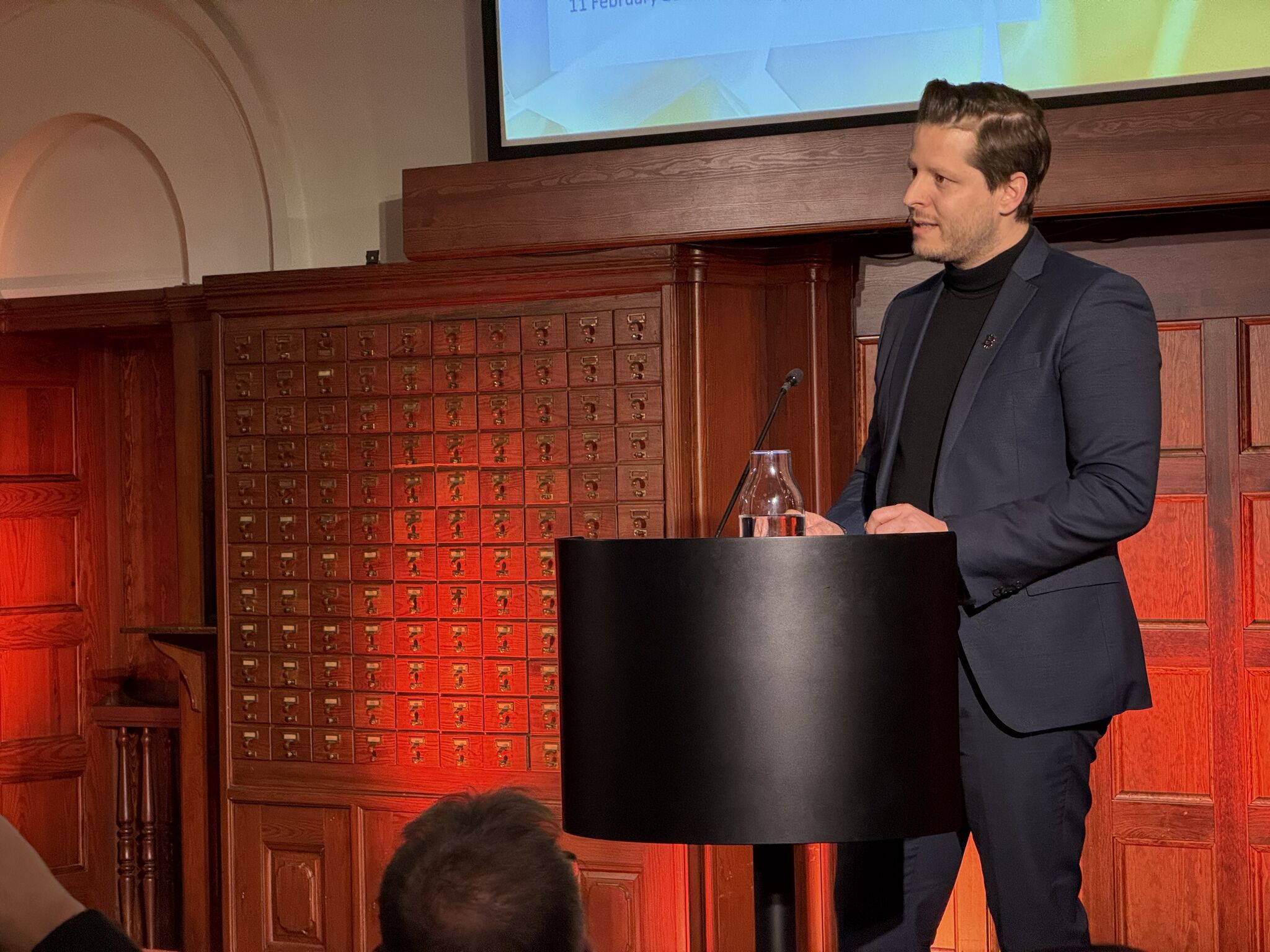
Thomas Eichenberger, Sygnum’s Deputy Group CEO & Chief Strategy Officer, delivered the inaugural “The Satoshi Nakamoto Annual Speech” at the National Library of Norway in Oslo, the day before the Norwegian central bank’s traditional annual address.
While the Governor of Norges Bank’s speech – titled “Economic Perspectives” since 1986 – reflects a tradition spanning more than 100 years, Thomas Eichenberger’s speech focused on money, technology, and society of the future.
Below is the full transcript of Thomas Eichenberger’s speech.
Good evening ladies and gentlemen, it is my great pleasure and honour to be here tonight to hold this inaugural Satoshi Nakamoto Annual Speech. Thank you very much, Morten, for the kind invitation and you and your entire team at BPI for the great organisation of tonight’s event!
Holding an inaugural speech has both advantages and disadvantages:
- You are the first – nobody has done it before! Hence, no one has set the bar, no basis for comparison has been set, no ground has been covered that you could not talk about without being perceived as repetitive
- You are the first – nobody has done it before! Hence, you don’t know what the expectations are, you cannot refer to previous speeches, or build on already established knowledge and facts
It is not an easy task in general. And I would argue in today’s case in particular, since Bitcoin offers such a broad spectrum of topics and perspectives one could talk about for hours and days and weeks, but we only have roughly half-an-hour today, hence a) I had to narrow it down to one perspective and b) I had to keep it reasonably short without losing the majority of you in the audience, not knowing how homogeneous or heterogeneous your previous knowledge on Bitcoin is.
I have chosen to present bitcoin from a monetary perspective within a modern, Western, and finance relevant perspective to create a thought-provoking contribution to the Norwegian public debate, but also the public debate in Western countries more broadly.
A few important remarks before we start:
- I am not speaking today with any type of political or economic mandate
- I am not here to discuss any Norway-specific monetary policy or economic indicators – as I am neither in a position to do so, nor do I think that they won’t be discussed in detail in tomorrow’s speech by the governor of Norges Bank
- I am here to share with you an independent view on Bitcoin’s use cases for Western economies and its evolving role in today’s world
- It is meant to have educational, inspirational and thought-provoking character, without the claim to be 100% right or wrong, nor predicting the future anywhere close to accurately
- But I sincerely believe that regardless of one one’s current position towards Bitcoin (critic, neutral, cautious believer, or Bitcoin maxi) engaging in this thought-process will be a valuable exercise
- And of course, as a banker, I should not forget to mention that none of my statements made in today’s speech should be interpreted as investment advice
Now taking that monetary perspective on Bitcoin, I have decided to structure my speech into 3 parts: The past, the present and the future – namely, what Bitcoin initially set out to become, what it has already become as of today, and what it might become in the future.
The Past: What Bitcoin set out to become
Bitcoin has its origin in the famous whitepaper published by Satoshi Nakamoto, a pseudonym for a person or group who ultimately created Bitcoin. The white-paper’s title was quite simple “Bitcoin: A peer-to-peer electronic cash system.”
As trivial as the title of the whitepaper may have sounded at the time, the “invention” of Bitcoin was a major break-through from a technological point of view, or as Eric Yakes put it later:
“The paper summarised a confluence of technologies that, when combined, created digital money. These technologies were the product of 4 decades of attempts and failures to create digital money.” (The 7th Property, Eric Yakes, 2021).
The primary reason why there had been so many failed attempts to create digital money before, was the so-called “double-spending problem” to which we will get in a minute.
In order to get to the bottom of what this break-through invention was comprised of, let’s first decompose the title of the whitepaper:
- P2P: Peer-to-peer means there is no trusted third-party required to execute a transfer with final settlement. Also, “peer” in this context does not necessarily mean an “individual” or a “person”, but it means any type of actor including large institutions, national banks, nation states, etc.
- Electronic: Electronic means it is natively fully digital and auditable
- Cash: “Cash” here is not meant in the sense of “pocket change”, but in the sense of it having monetary properties and it being a bearer asset with settlement finality
- System: System means the that there is an auditable, verifiable and immutable bookkeeping record via timestamped blocks of transactions and difficulty- adjusted proof-of-work algorithm maintained by a distributed, decentralised network instead of a centralised ledger maintained by a single authority
- Double-spend: The “double-spend” or “Byzantine Generals Problem” was a long-standing, seemingly unsolvable problem in computer science until Satoshi Nakamoto resolved it. In essence, the double-spend problem is the risk that the same amount of a digital currency could be spent twice. In traditional systems, a central authority (like a bank) prevents this by maintaining a private ledger. In a decentralised system, this is not trivial to be prevented when you have to assume that you will naturally have malicious actors who will try to exploit and cheat the system. Satoshi Nakamoto did it by combining the Proof-of-Work (PoW) consensus algorithm with a cryptographically-linked blockchain.
Or as Eric Yakes put it:
Bitcoin utilised digital signatures, the blockchain data structure, and computational puzzles to successfully create, for the first time in history, decentralised digital money. (Yakes, 2021).
Next, let’s double-click on the properties of Bitcoin (which are essential from a monetary perspective and its evolving role therein):
- Immutability of records:
Definition: once a transaction is recorded on the blockchain, it becomes practically impossible to alter, delete, or overwrite it. Unlike a traditional database where an (super)administrator can “rewrite history,” Bitcoin’s ledger is append-only, meaning you can only add new data, never take it away. On a technical level, immutability is maintained through cryptographic linking, where each block contains a unique hash of the previous block; any change to a past transaction would invalidate its hash and all subsequent blocks, requiring an attacker to redo the computational work for the entire chain—a feat that is economically and technically unfeasible in a decentralised network. Creating the “unforgeable costliness” as Nick Szabo described it.
Implication: This creates a trustless environment where users do not need to rely on central authorities to verify history, as the ledger provides an audited, permanent, and tamper-proof record of every transaction ever made since the network’s inception in 2009. The longest string of the blockchain is always the one where the most computing power went into, and hence the one that is true. - Verifiability of records:
Definition: The system operates on the principle of “Don’t Trust, Verify.”
Implication: Unlike traditional systems where you must trust a bank’s statement, any Bitcoin user can independently run a full node to verify the entire history and current state of the ledger themselves. - Decentralised / Intermediary-free / Trustless
Definition: A network architecture where power, control, and data are distributed across thousands of independent nodes globally, rather than being concentrated in a single server or entity.
Implication: This eliminates “single points of failure”, but also “single points of power and authority” in terms of central gatekeepers, making the network resilient against physical destruction, localised regulation, or the corruption of any single participant. - Permissionless (Global/Borderless in the wider sense):
Definition: Anyone anywhere can join the network, run a node, mine, or send a transaction without needing authorisation or identification from a third party.
Implication: It provides financial inclusion for the unbanked, requiring only an internet connection to access the full power of a global financial network. - Censorship-resistant/non-political:
Definition: No central authority (government, bank, or corporation) can block a transaction or simply expropriate a user’s funds.
Impact: This ensures the network remains neutral, treating all transactions equally regardless of the sender, receiver, or purpose. - Absolute scarcity / Disinflationary:
Definition: The protocol enforces a disinflationary supply schedule where maximum supply is strictly capped at 21 million coins. Nevertheless, Bitcoin is often described as one of the most divisible monetary asset in the world. While fiat money can be divided down to the cent (.01). Bitcoin can be divided down to the 8-th decimal after the comma, which is known as a satoshi or sat (.00000001) – 100 million sats make 1 Bitcoin.
Impact: This makes Bitcoin non-dilutable, as no central entity can “print” more to devalue existing holdings, often described by proponents as a potential hedge against monetary dilution - Thermodynamically sound:
Definition: Bitcoin’s difficulty-adjusted proof of work algorithm anchors the digital protocol to the physical universe by requiring the consumption of joules (energy) through Proof-of-Work, creating a real-world energy expenditure that cannot be faked, argued with, or reversed without an equal or greater expenditure of energy.
Implication: The difficulty-adjusted Proof of Work (PoW) consensus algorithm anchors Bitcoin to physical time, making history impossible to rewrite because an attacker cannot simply “compute faster” to catch up; they are bound by the same relentless, probabilistic arrow of time that governs the rest of the universe.
There are many famous individuals from the past and today’s world that have made famous quotes concerning the relationship between money and energy:
“Under the energy currency system, the standard would be a certain amount of energy exerted for one hour…to connect currency with energy.” Henry Ford, American industrialist, 1921.
“Wealth is the product of energy times intelligence: energy turned into artifacts that
advantage human life … The world energy system is the only realistic basis for a lasting economic accounting system” Buckminster Fuller, American Visionary, 1981.
Summarising this first chapter, it seemed like Bitcoin had finally achieved, what even Nobel-prize winning economist Milton Friedman had predicted in 1991, namely that “the one thing that is missing, but that will soon be developed, is a reliable e-cash, a method whereby on the Internet you can transfer funds from A to B, without A knowing B or B knowing A.”
The Present: What has become today
Today, it seems like that what was initially meant to solve the double-spend problem of digital money, suddenly emerged into what some describe as a new form of money with superior monetary properties and with the potential to become a new global monetary standard.
But before we jump to conclusions, let’s first have a closer look at what defines money: Milton Friedman and Allan H. Meltzer put it as follows:
“A commodity accepted by general consent as a medium of economic exchange. It is the medium in which prices and values are expressed; as currency, it circulates anonymously from person to person and country to country, thus facilitating trade, and it is the principal measure of wealth.”
Adding Carl Menger’s perspective that says: “Money is the good with the lowest rate of diminishing value.”
That’s why money is also often referred to as “the most salable good”.
In order to uphold this proposition, money must exhibit superiority in 6 particular properties categorised across time, space and scales. These properties are:
- Scarcity: Limited in supply relative to other goods
- Durability: Can be used repeatedly without losing its functionality/value
- Acceptability: Used by others and thus accepted widely in a group
- Portability: Capable of being moved across distances
- Divisibility: Can be divided into smaller units of value
- Fungibility: One unit is viewed as exactly the same as any other unit
Eric Yakes, in his book, the 7th property then made an attempt in comparing the how different types of money or goods comply with these 6 properties. From a theoretical monetary perspective, some analyses suggest that Bitcoin exhibits strong characteristics across several monetary properties, subject to adoption and market evolution.
And in addition, Bitcoin scores the maximum points on the 7th property the “immutability” property, which in this case means that the production and storage of the form of money are decentralised.
Despite its potential superiority in terms of monetary properties, it is not the case that new forms of money suddenly appear, immediately replace others and entirely take over. But such transitions typically take place in stages:
In “The Bullish Case for Bitcoin”, Vijay Boyapati outlines a specific evolutionary path that a new monetary good typically follows:
- Collectible: The asset is initially valued for its novelty. It is usually held by a small group of enthusiasts (early adopters) who anticipate its future value. At this stage, the market is small and highly illiquid.
- Store of Value (SoV): As more people recognise the asset’s monetary properties, its purchasing power increases. This is the stage where the asset’s total market value grows significantly. It is characterised by high volatility as the market tries to “discover” its fair price.
- Medium of Exchange (MoE): Once the asset has established a reasonably high and stable purchasing power, it begins to be used more frequently in trade. The volatility subsides because its value is widely recognised, making it practical to use for frequent transactions.
- Unit of Account (UoA): This is the final stage of maturation. Goods and services are priced directly in the asset rather than being converted from a secondary currency. It becomes the “yardstick” for value in the economy.
These stages of evolution towards the adoption of new form of money, or even towards a new global neutral monetary system are typically expected to be passed through in individual s-curves, whereby today we seem to be to quite clearly in the Store of Value phase.
Now let’s start to look at what is needed for new forms of money, and in our particular case Bitcoin, to transition through these stages? In essence, it requires developments and evolutions across 4 major domains:
- Adoption
- Market volatility and liquidity
- Technology
- Regulatory clarity
Now looking at what it took from Collectible to Store of Value we can observe the following:
Adoption:
- Initial grassroots adoption: Adoption in fringe communities (Cypherpunks, certain Austrian economists) as it happened between 2009-2017 (first large bull run where “broader retail adoption” phase started)
- Broader retail adoption (started in ~2017-ongoing): More individuals become aware of Bitcoin
- Institutional adoption (started in ~2020 with MSTR and then definitely in 2024 with the BTC ETFs): Corporations, pension funds, insurance companies, and sovereign wealth funds.
To give you one widely-used example: The launch of US spot Bitcoin ETFs in January 2024 has been widely reported as one of the most successful ETF launches in history, characterized by unprecedented, rapid inflows that, according to publicly available reports, far surpassed the historic debut of gold ETFs:
BTC ETFs reached ~$20bn inflows in <10 months, whereas Gold ETFs (launched in 2004) are widely reported to have taken ~5 years to reach this amount of inflows[i] - Nation-state adoption: So far only small nation states (El Salvador, Bhutan, etc.) adopted Bitcoin to a meaningful extent. However, according to the American Bitcoin Policy Institute, 27 countries currently have some measure of exposure to bitcoin, approximately one in seven worldwide. Furthermore, 13 countries have proposed adoption measures through legislation or policy initiatives, most commonly in the form of establishing a strategic Bitcoin reserve
Market volatility and liquidity: Characterised by high volatility and deepening market liquidity
Technology: Technological advancements for institutional-grade custody, on-chain risk and AML controls, auditability (including proof-of-reserves), etc.
Regulatory clarity: Regulatory treatment and accounting standards for the asset class, clarity on supervisory authority oversight, emergence of financial services and use cases
Like new forms of money go through stages of evolution the same is required from banks with regards to their adoption thereof. As Bitcoin moved from Collectible to Store of Value, banks had to take a decision whether they want to simply ignore the ever-increasing demand and adoption, or whether they aim to evolve from not offering any services related to Bitcoin to dealing in “Bitcoin proxies” such as BTC ETFs, offering Bitcoin basics, such as custody and brokerage, or moving towards becoming a “Bitcoin-native” service provider, offering more sophisticated use cases such as lending, transfers/payments, yield generation on Bitcoin, etc.
In order for banks to be able to embark on this evolutionary journey, a number of elements need to be put and fall in place across 1) Strategy, 2) Governance, 3) Processes, 4) Technology and 5) Regulation.
As mentioned before and in line with their stage of evolution from “non-Bitcoin” to “Bitcoin-native” financial institution, banks typically build out their services in stages, starting with the foundation to buy, hold, sell Bitcoin, before moving to more sophisticated use cases.
Key inhibitors for banking adoption are increasingly resolved. This includes the elimination of regulatory uncertainty (in Switzerland since the enforcement of the DLT
Act 2021, but now also in Europe with MiCA and the US), the readiness of instutional-grade market infrastructure (technological custody solutions, trading venue access, B2B2C turnkey integration solutions like we offer at Sygnum) as well as the increased understanding of the Bitcoin narrative as a potentially emerging new form of money.
To give you one example, in Switzerland more than 35 of the roughly 200 banks already offer Bitcoin-related banking services – this includes 2 of the 4 domestically systemically-important banks in Switzerland, as well as many partially- or fully state-owned banks such as PostFinance or the cantonal banks of Zurich and Lucerne.
The Future: What Bitcoin might become
As mentioned at the very beginning, no one can predict the future, hence neither can I. As much as there are thousands of factors influencing the future, there thousands of potential scenarios how the future could ultimately play out.
Since time does not permit me to talk about all the scenarios I could think of, I would like to continue on the one scenario – and would invite you all to join me on that thought experiment – where Bitcoin would truly continue on its evolutionary path to become a new form of money and move from its current Store of Value stage to the “Medium of Exchange” and later “Unit of Account” stage.
To move from Store of Value to Medium of Exchange we would probably need to see the following developments across the 4 dimensions introduced earlier:
Adoption:
- Merchant adoption: More businesses must accept Bitcoin directly for goods and services to create a circular economy where users don’t need to immediately convert back to fiat
- Case in point:
In November 2025, Jack Dorsey‘s Square activated LN payments on all point of sale terminals (>4mio in the US alone)
Merchants save the 3% credit card fee
Bitcoin Is a Step Closer to Being Money With Square Bitcoin Square Brings Bitcoin to Main Street with First Integrated Payments and Wallet Solution for Local Businesses
Market Volatility and Liquidity:
- Lower volatility and very deep liquidity
Technology:
- Scaling solutions: To overcome the 7-transactions-per-second limit of the main chain, Layer 2 networks (such as Lightning) are necessary to handle high-volume, instant, and low-fee transactions
Regulatory:
- Regulatory changes: In particular tax laws need to change so BTC so that small, everyday transactions do not trigger a tax event (i.e., capital gains tax – cf. “de minimis exemption” for BTC that is currently debated in US). Furthermore, regulatory clarity regarding Bitcoin payments, including licensing regimes for payment providers, is required
While the idea for Bitcoin to move from Store of Value to Medium of Exchange may already sound farfetched today, let’s dare to even think one step further where Bitcoin would move from Medium of Exchange to Unit of Account. Whereby Unit of Account means that people would start to think and speak in Bitcoin (or Satoshis) when they talk about the prices of certain goods.
As far-fetched as this may sound, let’s remind ourselves, that a mere decade ago Bitcoin itself was only micro-cap asset being speculatively exchanged within its primary communities of early believers and early users, whereas now it is a 1.3 trillion dollar asset.
So, what would it require for Bitcoin to move from Medium of Exchange to Unit of Account.
Adoption:
- Bitcoin being used in commodity pricing
- Bitcoin being used as international settlement currency
- Bitcoin as a global reserve asset
Volatility and liquidity:
- Very low volatility and extremely deep liquidity
Technology:
- Bitcoin network would have to become part of the world’s critical infrastructure (like the internet or power grids)
Regulatory/Politics:
- Bitcoin would need to be included in National reserve laws and National Security Strategies
Coming back to the adoption part: we might potentially need to see the following evolution:
Commodity pricing:
- Bitcoin would probably first need to become THE reference unit of account for the international trade of commodities (i.e., energy and raw materials)
- Nations and large producers of commodities would have to prefer a neutral – or non-political – asset to settle commodities trade, especially if they want to avoid today’s “privilege” of the US Dollar
- Once this would have established, we would reach the “Schelling Point”: Once major commodities are priced in Bitcoin, the volatility of Bitcoin against those goods decreases relatively. If oil is 100,000 sats/barrel today and 100,000 sats/barrel next month, it creates a stable economic signal for energy-intensive industries
- Furthermore, as Saifedean Ammous explains: Once the “base layer” of the global economy (namely energy and raw materials) are priced in Bitcoin, a top-down trickling effect occurs:
On the Production Cost side: If a manufacturer buys their energy, steel, and shipping in Bitcoin, their internal accounting and cost-basis are now suddenly Bitcoin-denominated.
On the Revenue side: To ensure they cover those costs and maintain a profit, it becomes logically simpler for them to sell their finished goods in Bitcoin as well.
Spillover Effect: Eventually, this flows down to the consumer. Once a business pays its suppliers and employees in Bitcoin, the “mental math” of converting back to fiat becomes a burden. At this point, Bitcoin becomes the general unit of account
International settlement currency (“FX unit of account”)
- Bitcoin’s properties could position it as a potentially superior international settlement currency compared to other options (such as the USD, the IMF’s SDR, or gold)
- Since like gold, Bitcoin is neutral to monetary policy of different countries and allows final settlement
- But unlike gold, Bitcoin is fast, cheap, and simple to verify
Global Reserve Asset
- Multipolar world order: Bitcoin’s appeal as a global reserve asset could particularly increase in a multipolar world order, where there is less trust between (blocks of) nation states
Bitcoin as common denominator: In such a world, no nation state or block of nation states wants to hold currency of other (groups of) nation states, since (i) it would make them dependent on foreign monetary policies; and (ii) foreign reserves could be confiscated.At the same time, (groups of) countries still need to settle between each other due to the nature of global commerce. In such a world, one could imagine Bitcoin becoming a common denominator - Strategic imperative to hold Bitcoin: If Bitcoin becomes the unit of account for international commodities and international settlements, it will make sense for nation states to own Bitcoin. This could even be reflected as a critical requirement in National Security Strategies (NSS) to ensure access to commodities and international settlement
- Bitcoin-backed national currencies: Some proponents argue that a national currency (to the extent that they are then still needed) that is not backed by Bitcoin could, in a hypothetical scenario, lose value compared to other currencies that are at least partially backed by Bitcoin
In summary, all the scenarios in the future that include the continued existence of Bitcoin are most likely to be found on a spectrum that poses the question whether we will rather see the “Financialisation of Bitcoin” which describes the phenomenon that Bitcoin-linked, -infused, or -related products increasingly start permeating the financial system, or whether we will see the Bitcoinisation of Finance, where basically Bitcoin becomes the new norm and reference unit of account for global Finance:
Since none of us can predict the future, it may be wise to simply stick to the famous quote from Satoshi Nakamoto that says: “It might make sense just to get some in case it catches on.”
[i] These figures are based on publicly available reports and are provided for illustrative purposes only.
Sign up for Future Finance
Join our 40,000 strong global community to future proof your investments. Sign up now to be the first to receive our news, product launches, industry reports and educational series.

Disclaimer: The information in this publication pertaining to Sygnum Bank AG (“Sygnum”) is for general information purposes only, as per date of publication, and should not be considered exhaustive. This publication does not consider the financial situation of any natural or legal person, nor does it provide any tax, legal or investment advice. This publication does not constitute any advice or recommendation, an offer or invitation by or on behalf of Sygnum to purchase or sell any assets. No elements of precontractual or contractual relationship are intended. While the information is believed to be from accurate and reliable sources, Sygnum makes no representation or warranties, expressed or implied, as to the accuracy of the information. Sygnum expressly disclaims any and all liability that may be based on such information, omissions, or errors thereof. Any statements contained in this publication attributed to a third party represent Sygnum‘s interpretation of the data, information and/or opinions provided by that third party either publicly or through a subscription service, and such use and interpretation have not been reviewed by the third party. Sygnum reserves the right to amend or replace the information, in part or entirely, at any time, and without any obligation to notify the recipient of such amendment / replacement or to provide the recipient with access to the information. Simultaneously, there is no obligation of Sygnum to inform recipients of information, if before provided information later becomes outdated, inaccurate or obsolete, unless otherwise provided by applicable law. The information provided is not intended for use by or distributed to any individual or legal entity in any jurisdiction or country where such distribution, publication or use would be contrary to the law or regulatory provisions or in which Sygnum does not hold the necessary registration, approval authorisation or license. Except as otherwise provided by Sygnum, it is not allowed to modify, copy, distribute or reproduce, display, license, or otherwise use any content for commercial purposes.