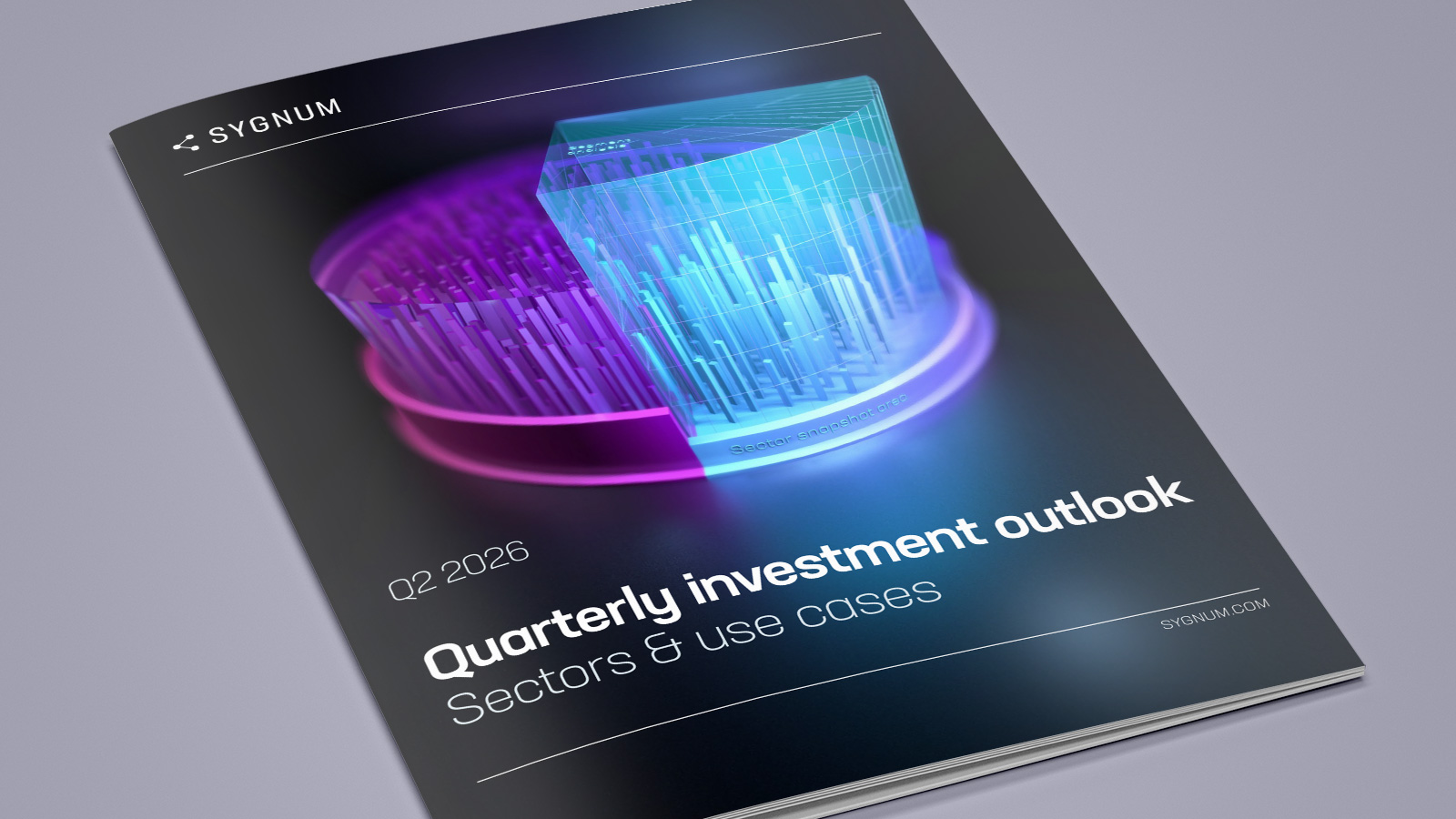
This is our Q2 2026 quarterly investment outlook, a report from Sygnum Investment Research.
Report highlights:
- The war in Iran and disruption to oil shipping routes through the Strait of Hormuz pushed markets firmly into capital preservation mode, with flows concentrating in hard assets, cash and short-duration instruments. Brent and WTI briefly hit USD 118 per barrel before pulling back as tanker flows partially resumed.
- Oil-driven inflation has tapered the window for rate cuts considerably, with CME fed fund futures now pricing just one cut through year-end, but crypto sold off regardless, making this the ninth time in ten FOMC meetings that Bitcoin has dropped post-announcement. The dot plot projected only one cut for 2026, and Powell’s tone was notably hawkish.
- Gold and silver ran well ahead of Bitcoin earlier last quarter before both cooled after their parabolic price action. The appetite for hard assets has since spilled over into oil, and to a lesser extent, on-chain equity indices, which partly explains the acceleration in Hyperliquid’s HIP-3 markets.
- Bitcoin has outperformed gold, the S&P 500 and the Nasdaq since the Iran conflict began in late February, rising 17 percent as each sell-off has held a higher floor. The Fear & Greed index recovered sharply from an all-time low of 5 in February to 58, which may indicate that sentiment is recovering ahead of the underlying market conditions.
- Liquidity has still not recovered from the October liquidation cascade, however, leaving the market vulnerable to crowded trades and weekend flushes. Crypto risk appetite is unlikely to recover meaningfully until the current ceasefire agreements hold and there is greater visibility on the rate cut path.
- The KelpDAO exploit on April 18 left Aave with nearly USD 200m in bad debt and triggered approximately USD 8.5bn in withdrawals from the leading lending platform. DeFi protocols have since begun tightening collateral requirements for liquid restaking tokens.
- KelpDAO followed the Drift Protocol exploit on April 1, which drained more than USD 285m and affected 11 Solana protocols. Both incidents have been attributed to North Korea’s Lazarus Group, bringing total state-linked DeFi losses past USD 575m in just under three weeks.
- Michael Saylor’s Strategy continued to buy aggressively throughout the quarter, acquiring more than 140k BTC year-to-date, funded increasingly through its STRC preferred issuance as its stock price declined and the premium over the value of its underlying BTC holdings fell to approximately 1x. Corporate demand outside of Strategy has slowed, however, as mNAV ratios across nearly two-thirds of public DATs now sit below 1.
- The CLARITY Act’s latest amendments saw Coinbase withdraw its support over stablecoin yield restrictions, and to a lesser extent, tokenised equity limits and DeFi surveillance provisions. The bill needs to clear the Senate this quarter or risk slipping behind US midterm priorities, so progress in May is now essential.
- The SEC and CFTC’s harmonisation efforts are encouraging, with coordinated work on taxonomy and product classification resolving much of the jurisdictional overlap that held back regulatory clarity in the US under Gary Gensler. However, the CLARITY Act is the outstanding piece that remains.
- Tokenisation reported remarkable growth and all-time highs across nearly all growth metrics as TradFi institutions remain fully committed to bringing capital markets on-chain. RWA value on permissionless rails grew 40 percent over the quarter to surpass USD 30bn, while permissioned networks such as Canton Network now manage more than USD 320bn in tokenised assets, predominantly in repo markets.
- Decentralised perp exchanges reported strong growth, with Hyperliquid’s HIP-3 open interest surpassing USD 2bn by mid-April as commodities and equity indices dominate market share. The first officially licenced S&P 500 index perpetual launched on March 18 through S&P Dow Jones Indices, and Hyperliquid’s platform revenue base is increasingly diversifying away from the crypto cycle.
- AI-linked tokens outperformed the broader crypto market, led by Bittensor’s TAO which rallied more than 90 percent after the release of its Covenant-72B model and a fresh allocation by Grayscale. The rally has attracted a wave of AI-themed memecoins and projects looking to piggyback on the narrative, however.
- Community pressure and tokens trading at multi-year lows have forced a number of projects to overhaul their tokenomics over the quarter, with Aave, Aptos, Balancer, Cosmos, MegaETH and Polkadot all announcing or implementing changes throughout supply caps, deflationary mechanics, KPI-driven unlocks and revenue sharing to improve the weak value accrual.
- Prediction market activity grew substantially over the quarter as geopolitical uncertainty and the expansion into sports betting drove combined monthly volumes between Kalshi and Polymarket toward USD 8bn. However, scrutiny around insider trading and war-related betting has increased. Kalshi faces greater regulatory exposure given its US concentrated userbase.
This report is available to qualified investors. Please find further insights and news from our team here.
Sign up for Future Finance
Join our 40,000 strong global community to future proof your investments. Sign up now to be the first to receive our news, product launches, industry reports and educational series.

Disclaimer: The information in this publication pertaining to Sygnum Bank AG (“Sygnum”) is for general information purposes only, as per date of publication, and should not be considered exhaustive. This publication does not consider the financial situation of any natural or legal person, nor does it provide any tax, legal or investment advice. This publication does not constitute any advice or recommendation, an offer or invitation by or on behalf of Sygnum to purchase or sell any assets. No elements of precontractual or contractual relationship are intended. While the information is believed to be from accurate and reliable sources, Sygnum makes no representation or warranties, expressed or implied, as to the accuracy of the information. Sygnum expressly disclaims any and all liability that may be based on such information, omissions, or errors thereof. Any statements contained in this publication attributed to a third party represent Sygnum‘s interpretation of the data, information and/or opinions provided by that third party either publicly or through a subscription service, and such use and interpretation have not been reviewed by the third party. Sygnum reserves the right to amend or replace the information, in part or entirely, at any time, and without any obligation to notify the recipient of such amendment / replacement or to provide the recipient with access to the information. Simultaneously, there is no obligation of Sygnum to inform recipients of information, if before provided information later becomes outdated, inaccurate or obsolete, unless otherwise provided by applicable law. The information provided is not intended for use by or distributed to any individual or legal entity in any jurisdiction or country where such distribution, publication or use would be contrary to the law or regulatory provisions or in which Sygnum does not hold the necessary registration, approval authorisation or license. Except as otherwise provided by Sygnum, it is not allowed to modify, copy, distribute or reproduce, display, license, or otherwise use any content for commercial purposes.